How to Sell Gift Cards in Shopify
A step-by-step guide to setting up Shopify gift cards and using them to increase sales, retention, and customer lifetime value.


Gift cards are built directly into Shopify, yet most store owners treat them as a seasonal add-on rather than a strategic revenue tool.
When implemented correctly, Shopify gift cards can do far more than generate holiday sales. They can improve cash flow, protect revenue from refunds, increase average order value, and serve as a retention mechanism inside your marketing system.
This guide will walk through how to set up gift cards in Shopify step by step. It will also explain how to use them intentionally to drive repeat purchases, create structured promotions, and issue store credit in a way that supports long-term growth.
01Part 1: How to Set Up Gift Cards in Shopify
Step 1: Enable Gift Cards in Your Shopify Admin
Shopify includes built-in digital gift card functionality on most paid plans. The feature is straightforward, but many stores never activate it properly or fail to merchandise it effectively.
To enable gift cards:
- Log into your Shopify admin.
- Navigate to Products.
- Select Gift cards.
- Click Add gift card product.
[IMAGE PLACEHOLDER – Shopify Admin > Products > Gift Cards Section]
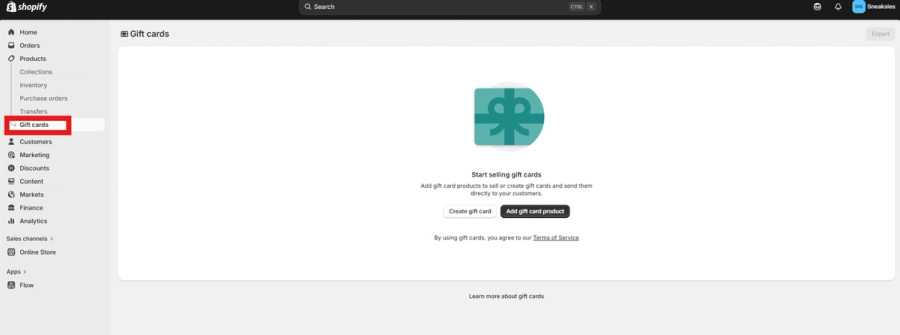
This creates a product specifically designated as a gift card, which behaves differently from standard inventory items. Gift cards do not require physical fulfillment and generate a unique code upon purchase.
Step 2: Configure Your Gift Card Product
Creating the gift card product requires the same level of attention you would give any revenue-generating product. Many stores rush through this step, which reduces perceived value.
When setting up your gift card product, you will define:
- Product name
- Description
- Available denominations
- Product imagery
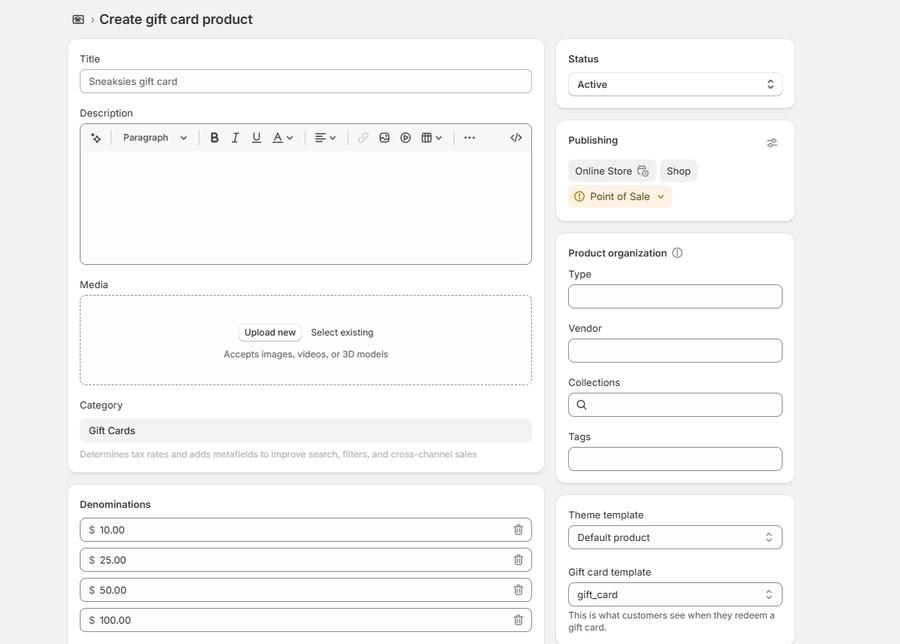
It is generally recommended to use fixed denominations such as $25, $50, $100, and $250. Fixed pricing simplifies reporting and makes it easier to structure promotional offers later.
Your product description should explain:
- How the gift card is delivered
- How it can be used
- Whether it expires
- Whether it can be combined with promotions
Clarity reduces customer support friction.
Step 3: Customize the Gift Card Email Experience
When a customer purchases a gift card, Shopify automatically generates and sends a digital gift card email. That email is part of your brand experience and should be treated as such.
To customize the notification:
Go to Settings, then Notifications, and locate the Gift card created template.
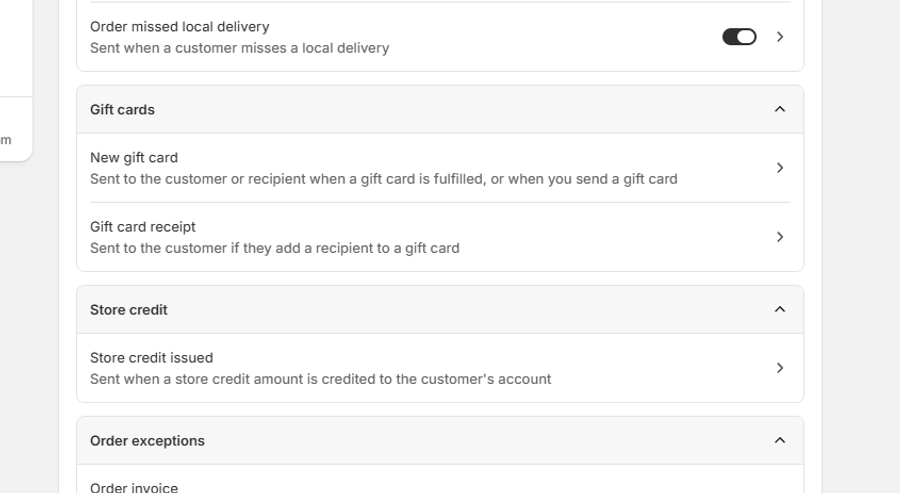
This template can be adjusted to:
- Match your brand voice
- Reinforce usage instructions
- Encourage immediate browsing
A well-designed gift card email increases the likelihood that the recipient uses it quickly.
Step 4: Make Gift Cards Visible
One of the most common mistakes store owners make is hiding gift cards in obscure collections or failing to link them clearly in navigation.
Gift cards should be accessible through:
- Main navigation during key seasons
- Footer menus year-round
- Dedicated landing pages during promotions
- Homepage banners during campaigns
Visibility directly impacts sales. If customers cannot easily find gift cards, they will not purchase them.
How to Use Shopify Gift Cards to Generate More Sales and Retain Customers
Setting up gift cards in Shopify is straightforward. But most store owners stop there — and miss the real opportunity.
Gift cards are one of the most under-appreciated tools for driving revenue, increasing retention, and creating ongoing customer engagement. Below are real tactics that brands use successfully.
Strategy 1: Run Gift Card Bonus Promotions to Boost Cash Flow
Instead of discounting products, use gift cards to offer bonus value.
This works particularly well during:
- Holiday seasons
- Slow sales months
- Launch periods
- Product releases
For example, a store might run a promotion like:
“Purchase a $100 gift card and receive a $15 bonus credit.”
Because the bonus credit must be redeemed later, the merchant receives $100 upfront and still drives future purchases.
Real-world benefit:
Customers feel they’re getting extra value without you discounting your catalog.
This tactic also increases upfront cash flow, which can be particularly powerful for seasonal inventory buys or vendor payments.
Strategy 2: Convert Refunds Into Store Credit With Incentives
Traditional refunds put money directly back into a customer’s bank account, ending the financial relationship.
However, many brands incentivize store credit instead of refunds. For example:
- “We can issue a refund, or we can issue store credit with a 10% bonus.”
In practice, many customers choose the credit because the bonus offsets inconvenience.
When issued as a gift card, that store credit becomes tracked revenue that brings the customer back for another purchase, often at full margin.
Shopify makes this easy:
Go to Products > Gift Cards > Issue Gift Card and send it directly to the customer’s email.
This tactic is especially effective for brands with high return rates, where retaining revenue is a priority.
Strategy 3: Increase Average Order Value With Threshold-Based Rewards
Instead of cutting prices outright, offer gift card incentives for higher cart totals. Examples include:
- “Get a $20 gift card when you spend $150 or more.”
- “Spend $300 today and get a $50 bonus credit.”
This creates a psychologically attractive goal post and increases average order value (AOV).
Real-world outcome:
Customers often increase their cart size just enough to unlock the bonus gift card, and then return to spend that bonus later — frequently spending more than the original amount.
This tactic creates two revenue events instead of one.
Strategy 4: Use Gift Cards to Win Back Inactive Customers
Dormant customers — those who haven’t purchased in 60–120 days — are expensive to reacquire through ads.
Instead of discounting broadly, many brands use targeted re-engagement campaigns with gift cards. A typical email might read:
“We miss you! We’ve added a $15 credit to your account. Use it on your next purchase.”
Gift cards have psychological advantages over standard discounts because:
- They feel like earned value
- They preload the next purchase
- They create a sense of urgency to redeem
This type of win-back email often outperforms straight percentage-off offers because it feels more personal and valuable.
Strategy 5: Fuel Loyalty Programs and Repeat Purchases
Gift cards can form the foundation of loyalty systems.
Examples of loyalty implementations include:
- Awarding store credit for reaching purchase milestones
- Providing credit for completing product reviews
- Rewarding referrals with redeemable credit
By integrating gift cards into loyalty systems, merchants can:
- Increase customer lifetime value (LTV)
- Create structured retention frameworks
- Reduce reliance on discounts
For example:
A skincare brand might send a $10 credit when a customer reaches 5 purchases, which encourages them to stick with the brand to unlock further rewards.
Strategy 6: Use Gift Cards in Bundles and Cross-Sell Offers
Gift cards can be included in product bundles as a perceived value enhancement.
Examples:
- Holiday bundle includes a gift card with purchase
- Subscription box includes a surprise credit
- Gift sets paired with a promotional credit for future use
In the real world, this works because the gift card becomes part of the value proposition rather than a discount that erodes margin.
Customers feel like they are “getting more,” and you retain control over how and when that credit is redeemed.
Strategy 7: Drive Referral Programs With Credit Incentives
Instead of offering cash or percentage discounts to referrals, some brands give:
- $10 credit to the referrer
- $10 credit to the referred friend
This approach is effective because:
- It creates a shared benefit
- It encourages both parties to return and spend
- It keeps dollars inside your ecosystem
Referral programs with gift card credit incentives often outperform cash incentives because customers engage more deeply with the brand to earn and redeem their credits.
Strategy 8: Automate Lifecycle Triggered Credits
Automation takes gift cards from promotional tools to core lifecycle infrastructure.
Examples of automated credit triggers:
- Birthday credit (e.g., “Happy Birthday! Here’s a $10 credit.”)
- Post-purchase follow-up credit
- Milestone credits after a certain number of days since last purchase
By using automation tools like Shopify Flow or Klaviyo, you can set these triggers so credit is issued automatically — reducing manual workload and increasing retention.
This is one of the most powerful but underused strategies among Shopify brands.
Strategy 9: Use Gift Cards to Encourage Early Access and Pre-Orders
Gift cards can be used to reward early purchasers or incentivize pre-orders.
Example:
- Customers who pre-order a new product receive a $20 gift card for later use.
This drives urgency and provides future revenue, making launches more predictable.
Strategy 10: Leverage Gift Cards for Seasonal Campaigns
Holiday gift card campaigns are obvious, but top-performing stores also use them during:
- Back-to-school
- Black Friday / Cyber Monday
- Valentine’s Day
- End-of-season clearance
Seasonal gift card offers can outperform product discounts because they:
- Increase upfront revenue
- Reduce inventory risk
- Drive future engagement
What This Looks Like in Practice
Successful Shopify brands often combine multiple strategies:
- Incentivizing higher AOV with gift card bonuses
- Using store credit to retain customers instead of refunds
- Running targeted re-engagement campaigns
- Automating gift card issuance for birthdays and loyalty milestones
When gift cards are used consistently and systematically, they stop being a “nice to have” and become a revenue engine.
Real World Results You Can Expect
If executed properly:
- Average order value often increases by 10–25%
- Customer return rates improve measurably
- Refund cost leakage is reduced
- Cash flow increases during key periods
- Loyalty and repeat purchase frequency rise
These are not hypothetical outcomes — these are results seen by brands that integrate gift cards into promotion calendars and lifecycle systems.
Sources
- Shopify Help Center: Selling Gift Cards
- Shopify: Issue a Gift Card
- Shopify: Edit Notification Templates
- Shopify Flow Documentation
- Klaviyo: Customer Retention Strategies
- HBR: The Value of Keeping the Right Customers
- Bain: Increasing Customer Retention
- Invesp: Average Order Value Statistics
- Federal Trade Commission – Gift Card Rules
Frequently Asked Questions
How do I set up gift cards in Shopify?+
Can I issue store credit in Shopify?+
Do Shopify gift cards expire?+
Are Shopify gift cards physical or digital?+
Can customers use gift cards with discount codes?+
How can gift cards increase average order value?+
Should I use gift cards instead of discounts?+
+
Ready to Turn Simple Features Into Real Revenue Systems?
Gift cards are easy to activate. Building structured promotions, retention flows, and automation around them is where real growth happens. If you want help implementing gift cards as part of a broader Shopify growth and automation system, we work with brands that want more than one-off tactics. We help build the infrastructure behind consistent revenue. Explore how we support Shopify stores below.
