How to Increase AOV for a Shopify Fashion Brand (Bundles, Upsells, and Merchandising Systems)
Most Fashion Brands Try to Scale by Buying More Traffic When They Should Be Increasing Revenue Per Customer First.

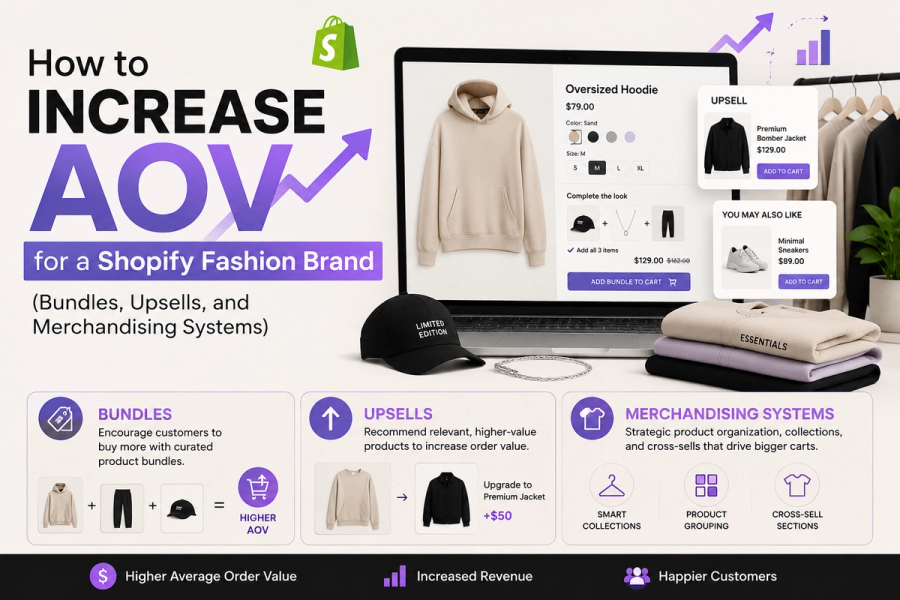
Most fashion brands try to scale by buying more traffic when they should be increasing revenue per customer first.
Customer acquisition costs continue to rise across Meta and TikTok. A 10 percent increase in AOV adds 10 percent to revenue without spending a single additional pound on ads. When that AOV increase is compounded across thousands of monthly orders, the revenue impact dwarfs most paid media optimisation efforts. Yet most fashion brands have no systematic approach to increasing order value beyond generic product recommendations that get ignored.
Fashion ecommerce has a category AOV of $141 on average according to Kard's 2026 industry benchmarks. Shopify fashion stores typically fall between $86 and $120 depending on sub-category, per EasyApps' 2026 fashion ecommerce guide. The gap between where most brands sit and where top performers operate is almost entirely explained by the presence or absence of deliberate bundle, upsell, and visual merchandising systems. This guide explains how to build them.
01What Is AOV and Why Does It Matter More Than Traffic?
Average Order Value is your total revenue divided by your total number of orders over a defined period. AOV equals total revenue divided by total orders. If your store generates $85,000 from 1,000 orders in a month, your AOV is $85.
The reason AOV is underinvested relative to its impact is structural. Traffic growth feels like expansion: more campaigns, more spend, more reach. AOV improvement feels like tinkering: adding a bundle here, adjusting a recommendation widget there. The revenue math tells a different story. A fashion brand with 2,000 monthly orders at an $85 AOV generates $170,000 per month. Increasing AOV to $102, an 18 percent lift from a free shipping threshold and outfit bundling, generates $204,000 from the same 2,000 orders, $34,000 in additional monthly revenue with zero additional acquisition cost. That is what a functioning AOV system produces.
Higher AOV also directly improves the economics of every acquisition channel. A brand that can afford to pay $35 CAC at an $85 AOV with 50 percent gross margin has a contribution margin of about $7.50 per order before fixed costs. The same brand at $102 AOV has a contribution margin of approximately $16. That is double the contribution from the same ad spend, which means the brand can either be more profitable or spend more on ads to grow faster. AOV is the multiplier on every acquisition investment.
02Why AOV Matters Specifically in Fashion Ecommerce
Fashion is the most naturally bundleable product category in ecommerce. People do not dress in individual garments selected in isolation. They dress in outfits. A customer who arrives on your site looking for a jacket is implicitly in the market for the entire look that the jacket belongs to. The styling inspiration they consumed on TikTok or Instagram before arriving included shoes, trousers, and accessories. The appetite for the complete look exists before they land. A brand that only sells them the jacket is leaving the rest of the outfit on the table.
Fashion purchasing is also emotionally and identity-driven in a way that most product categories are not. Customers buy aspiration: who they want to be, how they want to be seen, the version of themselves they are constructing. A brand that sells into that identity-driven purchasing context can capture significantly more per transaction than a brand that presents its catalogue as an inventory list. The AOV systems described in this article work in fashion because the category's emotional mechanics naturally support them.
03The Biggest AOV Mistakes Fashion Brands Make
Selling products individually instead of as looks. Every product page that shows only the featured item without the coordinating pieces is a missed outfit sale.
Generic product recommendations. Showing "customers also viewed" carousels populated by algorithm rather than by a merchandising strategy produces irrelevant recommendations that get ignored.
No free shipping threshold. A free shipping threshold set 20 to 30 percent above current AOV is one of the simplest and most consistently effective AOV levers available. EasyApps' 2026 fashion guide reports that fashion stores using free shipping progress bars see AOV increases of 12 to 22 percent.
No post-purchase upsell. The moment immediately after checkout is the highest-intent purchasing moment in the customer journey. The customer has already committed and their credit card is still warm. A relevant post-purchase offer at this moment converts significantly better than any pre-checkout offer, yet most fashion brands have no post-purchase flow at all.
04The Core AOV Systems for Fashion Ecommerce
A. Outfit Bundling: Selling Looks Instead of Individual Products
Outfit bundling is the highest-AOV lever available to fashion brands because it works with the natural mechanics of how fashion is consumed rather than against them. A customer who wants the jacket also wants to look like the model wearing the jacket. Showing them the complete look on the product page, with each item clearly identified and shoppable, converts the aspiration directly into multiple items in one cart.
Product bundle data from Swell confirms that bundles lift AOV 20 to 35 percent on average, with best-in-class implementations reaching 55 percent. Bundled customers also show 2.7 times higher lifetime value than single-item buyers, according to the same research.
The practical implementation has three components. A Complete the Look section on every product page showing the coordinating items from the same editorial shoot, with each item individually addable to cart. A bundle discount that makes purchasing the complete look more compelling than buying items individually, typically 10 to 15 percent off when two or more coordinating items are purchased together. Curated outfit collections on the homepage and collection pages that lead with the full styled look rather than individual products.
B. Cart Upsells: High-Value Attachment Items
Cart upsells are offers presented when a customer has already committed to their main purchase and is reviewing their cart or proceeding to checkout. In fashion, the most effective cart upsells are small, high-margin complementary items: jewellery, belts, socks, scarves, hair accessories, bags, and seasonal essentials.
Shopify's own AOV guide recommends low-value upsells specifically for this reason: if someone is purchasing $50 to $100 worth of clothing, getting them to add another $100 item is difficult. Getting them to add a $20 belt that completes the outfit is straightforward. The perceived value of the belt in the context of the existing cart is high. The purchase resistance is low. This is the economics of small complementary items in fashion.
C. Free Shipping Threshold
A free shipping threshold set 20 to 30 percent above your current AOV creates a natural incentive for customers to add another item rather than pay for shipping. The threshold works in fashion because the product catalogue naturally offers low-friction additions: if a customer is at $85 and your threshold is $110, a pair of socks or a hair accessory gets them there without meaningful deliberation.
Displaying a free shipping progress bar throughout the shopping experience, from the product page through the cart, is critical for this to work. A threshold that is not visible does not influence behaviour. Research cited in Ringly.io's 2026 AOV statistics report confirms that free shipping thresholds set 30 percent above current AOV drive 15 to 25 percent AOV lifts when paired with a visible progress indicator.
D. Quantity Breaks for Fashion Basics
Quantity break discounts are particularly effective in fashion for basics, essentials, and repeatable items: T-shirts, socks, underwear, loungewear, and seasonal staples. A customer buying one white T-shirt for $35 who is offered three for $90 with a 14 percent saving will frequently take the bundle, particularly for wardrobe essentials they know they will need regardless. Quantity breaks work on the logic that the decision to buy has already been made and the only question is how many.
E. Post-Purchase Upsells
The order confirmation page is the most underused AOV surface in fashion ecommerce. The customer has completed their purchase. The checkout friction has been resolved. They are in a satisfied, high-intent state. A relevant post-purchase offer presented at this moment, a matching accessory, a complementary piece from the same collection, or a seasonal essential, converts at significantly higher rates than pre-checkout offers because there is no purchase anxiety to overcome.
Aftersell's 2026 research confirms post-purchase and thank-you page upsells convert 3 to 5 times higher than pre-checkout offers. AfterSell reports AOV lifts of up to 30 percent from post-purchase flows for merchants who implement them correctly. The ReConvert analysis in GetMesa's 2026 AOV guide cites a 5.6 percent AOV increase from post-purchase offers alone, which compounds significantly across monthly order volume.
05Fashion Merchandising Psychology: People Buy Looks, Not Products
Understanding why fashion AOV optimisation works requires understanding fashion purchasing psychology. Fashion customers do not approach a product page with a clinical evaluation of a garment's specifications. They approach it with an emotional response to an aesthetic and a desire to inhabit that aesthetic.
Styling inspiration is purchased, not just viewed. When editorial photography or lifestyle imagery makes a complete look desirable, the customer's aspiration encompasses the full outfit. Complete-the-look upsells are not cross-sells in the traditional sense. They are the natural conclusion of a purchasing decision that was already made emotionally when the customer first saw the styled image.
Seasonal buying behaviour amplifies this further. Fashion customers shop seasons, not products. They are building a wardrobe for summer, updating their look for autumn, or refreshing their workwear for a new job. A brand that presents products as part of a coherent seasonal narrative creates the context for larger, more intentional purchases. A brand that presents products as individual SKUs interrupts that narrative.
06Product Page Optimisation for Higher Basket Size
A fashion product page that is only designed to convert a single item is an AOV failure. The product page is the highest-intent surface in your store and should be doing multiple jobs simultaneously: converting the primary item, surfacing the complete look, presenting a size or colour upsell, and showing the shipping threshold gap.
The Complete the Look section should sit below the add-to-cart button, not at the bottom of the page. Positioning it above the fold on desktop and immediately below the primary CTA section on mobile ensures it is seen by customers in the moment of highest purchasing intent. Each item in the look should be individually shoppable with a single click. EasyApps' 2026 fashion guide reports that complete-the-look upsells increase AOV 15 to 25 percent for fashion stores when properly positioned.
AI product recommendations that are trained on purchase behaviour rather than simple category matching surface more relevant outfit pairings. Ringly.io's 2026 AOV statistics confirm that AI product recommendations push AOV up 20 to 25 percent on typical Shopify stores, compared to manual or rule-based recommendation systems. The difference is relevance: an AI recommendation engine learns which items are actually purchased together by customers with similar profiles, which produces outfit suggestions that feel curated rather than algorithmic.
07Best Shopify Apps for AOV Optimisation in Fashion
Rebuy
Rebuy is the most comprehensive AI-powered personalisation and upsell engine available for Shopify. It powers upsells and dynamic bundle recommendations across every surface of the storefront: product pages, cart, checkout, post-purchase, and email. For fashion brands, Rebuy's SmartCart is particularly effective because it surfaces outfit recommendations and complementary items at the cart stage using behavioural data from previous purchase combinations. Rebuy consistently achieves 10 to 25 percent cart conversion rates on its upsell widgets. Best for: mid-market to enterprise fashion brands that want a unified upsell and recommendation system across the entire customer journey.
AfterSell
AfterSell is the leading post-purchase upsell app on Shopify, focused specifically on thank-you page monetisation. Its Smart Funnels use customer data to select the most relevant post-purchase offer for each buyer, rather than showing the same offer to all customers. Paid plans start at $4.99 per month with a free plan available for lower-volume stores. AfterSell reports up to 30 percent AOV lifts for merchants using its post-purchase flows, with post-purchase offers converting 3 to 5 times higher than pre-checkout offers. Best for: any fashion brand that has not yet implemented a post-purchase upsell, as this is the highest-impact, lowest-friction AOV intervention available.
Zipify OneClickUpsell
Zipify OneClickUpsell is designed for high-volume DTC brands and Shopify Plus merchants who want granular control over upsell funnel logic. It handles both pre-purchase checkout upsells and post-purchase offers, with split-testing built in. Pricing starts at $35 per month. Best for: fashion brands at significant scale with a dedicated conversion optimisation team that wants to test multiple upsell combinations and measure lift with statistical confidence.
Frequently Bought Together
Frequently Bought Together surfaces product combinations based on actual purchase history from your store, creating recommendation widgets that reflect genuine customer behaviour rather than category-based rules. For fashion, it naturally learns which items customers buy together as complete outfits. A low-cost, low-setup option for brands that want behaviour-based recommendations without the complexity of a full platform like Rebuy. Best for: early-stage fashion brands implementing their first product recommendation system.
Bundler
Bundler is a dedicated Shopify bundle app that handles fixed bundles, mix-and-match bundles, and quantity break discounts. For fashion brands, it enables the infrastructure for outfit bundles with tiered discounts, mix-and-match wardrobe builders where customers select from a defined set of tops, bottoms, and accessories to build their own bundle, and quantity break pricing for basics. Pricing starts with a free tier. Best for: fashion brands building an outfit bundle system without a full personalisation platform.
LimeSpot
LimeSpot is a personalisation and merchandising platform that manages product recommendations, complete-the-look widgets, and cross-sell placements across the storefront. Its fashion-specific Complete the Look widget is designed for editorial-style product page layouts. Best for: fashion brands that want a dedicated merchandising platform to manage outfit recommendations separately from their upsell and bundle systems.
08The AOV Testing Framework for Fashion Brands
The critical risk in AOV optimisation is increasing basket size while decreasing conversion rate, producing no net revenue gain. If AOV increases by 15 percent but conversion rate drops by 20 percent, the overall result is negative. The metric that captures this relationship is Revenue Per Visitor (RPV), which equals conversion rate multiplied by AOV. Optimise for RPV, not AOV in isolation.
Test each AOV intervention independently with a clear before-and-after measurement window. Implement one change at a time, measure for two to four weeks, and confirm that RPV has improved before proceeding to the next intervention. Priority order for testing based on implementation ease and expected impact: free shipping threshold first, as it requires only a configuration change and consistently produces 12 to 22 percent AOV lifts in fashion without any conversion rate penalty. Post-purchase upsell second, as it operates after checkout completion and has no conversion risk. Complete-the-look product page section third. Cart upsell widget fourth.
Track AOV weekly in Shopify Analytics under Reports and Customers. Segment AOV by traffic source, device type, new versus returning customers, and product category. The segmentation reveals which acquisition channels produce the highest-value customers, which device types are most susceptible to AOV-depressing mobile UX issues (desktop AOV runs 30 to 40 percent higher than mobile globally), and which product categories have the most bundle and upsell potential.
09Common Mistakes That Hurt Fashion AOV
Aggressive upsells that damage UX. Interstitial pop-ups and forced upsell steps that interrupt the purchase journey increase abandonment more than they increase basket size. Upsells should feel like helpful suggestions, not obstacles.
Irrelevant product recommendations. Showing a customer who bought a formal dress an outdoor hiking jacket undermines trust and trains users to ignore all recommendation widgets. Relevance is the entire mechanism by which recommendations generate AOV lift.
Over-discounting to drive AOV. Heavy bundle discounts that erode gross margin in pursuit of higher AOV can produce higher revenue figures with lower actual profit. Calculate the contribution margin impact of every discount structure before implementing it at scale.
Poor mobile merchandising. Fashion ecommerce is 72 percent mobile traffic according to EasyApps' 2026 fashion guide. Desktop AOV runs 30 to 40 percent higher than mobile globally. The AOV gap between mobile and desktop is almost entirely explained by worse mobile UX for bundle discovery and upsell presentation. Every AOV system must be optimised for mobile first.
10Fashion Brands Grow Faster When They Sell Complete Looks, Not Isolated SKUs
The global online fashion market reached $820 billion in 2025 and is projected to surpass $1 trillion by 2027, according to Statista data cited in EasyApps' fashion ecommerce guide. The brands capturing a disproportionate share of that market are not necessarily the ones spending the most on paid acquisition. They are the ones whose merchandising systems capture the maximum revenue from every customer who arrives.
Start with the free shipping threshold: it is the fastest implementation with the most consistent results. Add AfterSell or a similar post-purchase upsell app to capture the order confirmation moment. Build a Complete the Look section onto your top ten product pages. Add a cart upsell widget surfacing small, relevant accessories. Measure RPV before and after each change. The compounding effect of these systems, implemented sequentially and measured correctly, produces AOV gains that transform the unit economics of the entire acquisition operation.
Sources
- EasyApps Ecom: Fashion Ecommerce on Shopify Complete Strategy Guide 2026 (AOV $86-120, Complete-the-Look 15-25% Lift, Free Shipping 12-22% Lift)
- Ringly.io: 45 Average Order Value Statistics You Need to Know 2026 (Fashion AOV, Bundles 20-35% Lift, Repeat Customers 4.8x, Free Shipping Thresholds)
- Kard: 10 Proven Ways to Increase Average Order Value 2026 (Fashion $141 Category AOV, Bundling 55% Lift, Cross-Sell 30% Revenue)
- AfterSell: Top Shopify Upsell Apps to Increase AOV 2026 (Post-Purchase 3-5x Conversion, 30% AOV Lift, Smart Funnels)
- GetMesa: Shopify Average Order Value Proven Strategies 2026 (ReConvert 5.6% Post-Purchase AOV, RPV Framework, Desktop vs Mobile Gap)
- Shopify Blog: Average Order Value Formula Benchmarks and 7 Ways to Increase It 2026 (Rebuy AI Engine, Low-Value Upsell Psychology)
- Envive.ai: 39 AOV Boost Statistics 2026 (AI Recommendations 369% Lift, 90th Percentile Shopify AOV $326, BNPL 40% AOV Increase)
Frequently Asked Questions
What is the average AOV for Shopify fashion brands?+
What is the fastest way to increase AOV for a fashion Shopify store?+
Do bundle discounts hurt profit margins in fashion ecommerce?+
Which Shopify app is best for complete the look upsells in fashion?+
Why is mobile AOV lower than desktop AOV in fashion ecommerce?+
Should I add upsells before or after checkout?+
How do I measure whether AOV optimisation is working?+
Fashion Brands That Sell Complete Looks Generate More Revenue Per Customer Than Brands That Sell Isolated SKUs.
We build the bundle infrastructure, upsell flows, and merchandising systems that increase AOV for Shopify fashion brands. Book a free call and we will audit your current setup.
