Who Should You Hire to Grow Your Shopify Store — and Why Most Brands Get This Wrong
If your Shopify store is stuck between $10k and $40k a month and you've already tried to fix it yourself, this is the article that tells you exactly what you actually need and why everything you've tried so far hasn't worked.


For most Shopify store owners there is a version of the business in their head that is just slightly out of reach. The product is real. The customers exist. But somewhere between where the store is today and where it should be performing there is a gap that never seems to close no matter how much time or money goes into it.
A lot of that comes down to one thing. The day to day never slows down enough to actually build what needs to be built for growth. You are either running everything yourself and growth keeps getting pushed because operations come first, or you have stepped back and the execution layer underneath you is inconsistent and nobody is really owning the outcome.
Either way the result is the same. The brand is not moving the way it should and you know it.
If you are reading this you are probably at the point where you are starting to seriously think about what kind of help actually makes sense. Not just another freelancer for one task. Not a bloated agency retainer. Something that actually changes how the business runs and what the numbers look like six months from now.
That is exactly what this breaks down.
01Why your store is not growing (the real diagnosis)
Most Shopify stores stuck at $10k to $40k a month do not have one broken thing. They have five or six small breaks happening simultaneously, and because nobody is looking at the whole funnel at once, none of them get fixed completely.
Here is what that typically looks like in practice:
- Ads are running but there are product page does not match the creative's promise, so clicks do not convert
- Conversion rate is sitting at 0.8% to 1.2% when industry best practice for a healthy Shopify store is 2% or above
- Customers buy once and never return because there is no real retention system, no post-purchase flows, no loyalty mechanism, no re-engagement sequence
- No UGC pipeline, so social proof is thin and acquisition costs stay high
- No affiliate or influencer system, so growth depends entirely on paid ads with no compounding effect
- Upsells and cross-sells are either missing or set up wrong, leaving AOV lower than it should be
- No person to manage or grow my pipelines
Any one of these leaks costs you revenue. All of them together means you are running hard on a treadmill, spending money on traffic that your funnel is not built to convert and retain.
The thing most brands miss: this is not a knowledge problem. Most store owners at this stage already know what best practice looks like. The problem is time, systems, and execution. Nobody is there to build and monitor the complete funnel while you're not there.
02What you have already tried and why it did not work
Doing it yourself
Honestly this is not a bad place to start. One of the best things a business owner can do early on is learn how the work actually gets done. You understand the ad account, you know how to set up a product page, you have a real foundation. That knowledge matters because when you eventually bring someone in you can ask real questions and you are not relying on someone else to tell you what good looks like.
The problem is not that doing it yourself was the wrong call. The problem is time. Specifically the gap between what you can do and what an operator doing this full time at an expert level can do. You can learn most things given enough time. But time is exactly what you do not have. The bottleneck of doing it yourself is not capability. It is that there are only so many hours and growth keeps losing to operations.
Hiring freelancers
The issue most people run into with freelancers is not that good ones do not exist. It is how they get hired. Most store owners price shop. They find someone, get the task done, and move on. The problem is that the people who are actually good at this are in demand and they know it. If you are not treating them like a long term partner they are not going to treat your business like one either. A freelancer hired for a one-off task has one-off investment in your outcome. You get what the structure incentivizes and a task-based structure incentivizes completing the task, not growing your brand.
The deeper issue is that even a great freelancer is only seeing one piece. The person building your product page is not talking to the person running your ads. Nobody is looking at the full picture. You end up with three separate good things that never actually work together as a system.
Going to an agency
The sales process is always impressive. Then you get onboarded and handed to an account manager who was not in the sales call. The person doing the actual work on your account is splitting their time across a dozen other clients and you are probably not the biggest one.
The other thing worth knowing is that most agencies specialize in one thing. An email agency charges you $4k a month for email and then refers you to someone else for UGC, someone else for affiliates, and someone else for conversion optimization. Each of those referrals comes with its own retainer. Suddenly you are coordinating four separate vendors, paying $12k to $16k a month across all of them, and still nobody is looking at how all of it connects. If you are going to use a specialized agency, pick one, get that function right, and rotate when you are ready. Do not try to run all of them at once before the fundamentals are solid.
The pattern across all three
None of them are looking at your whole funnel. They are doing their piece and the rest stays on you. That is the real reason things have not moved the way they should.
| Freelancer | Agency | In-house hire | Us |
|---|---|---|---|
| Paid by the hour | High overhead cost | Full salary plus benefits | Monthly retainer, no contract |
| One skill, one task | Account manager layer | One specialization | Full funnel ownership |
| No funnel ownership | Slow communication | Months to ramp up | Dev plus marketing plus systems |
| You manage them | Built for churn | Needs management | One direct contact |
| Not outcome-aligned | Your brand is one of many | High fixed cost | Outcome-oriented |
The growth operator model exists because brands at this revenue stage do not need four specialists. They need one person who can audit the entire funnel, identify where the leaks are, build the systems to fix them, and keep optimizing until the numbers move.
Compared to Hiring In-House
When most store owners think about bringing someone in they are thinking about a salary, an hourly rate, or a traditional employment setup. Someone who owns a function, shows up every day, and is part of the team. That structure makes sense eventually. But it comes with expectations on both sides. The person you hire in-house wants stability, a clear role, and a path. You are taking on a fixed cost whether the month goes well or not and you are responsible for managing them, keeping them motivated, and making sure their time is being used well.
Working with us is different. You pay a flat monthly rate and you know exactly what you are getting for it. No quotes for every new task. No back and forth about what is in scope. No managing someone's schedule or filling their time. The work gets done and you can see it.
The other thing that is different is flexibility. An in-house hire is usually built around one function. They own email or they own ads or they own the store. We fit in where you actually need us. Some months that is building out a new affiliate pipeline. Some months it is fixing a product page that is not converting. Some months it is setting up automations that take the operational weight off your plate. The scope follows what the business actually needs right now rather than a job description written six months ago.
03What a Shopify growth operator actually does
We handle everything from the development side of your store to the marketing systems that drive and retain customers. If it touches revenue we can own it.
This includes Shopify development, product pages, email and retention, UGC and influencer campaigns, affiliate programs, ad alignment, post-purchase flows, upsells, and backend automations.
Not all of it runs at once. Priorities are set based on where the highest leverage is in your specific funnel. But all of it is available under one engagement, executed by one person who understands your brand from the first conversation with no handoffs, no account managers, and no repeating yourself.
04How fast do you see results?
Week 1 to 2 Funnel audit complete, priorities set, first assets built. If campaigns are ready, initial data starts coming in within two weeks of launch. Day 30First optimization cycle complete. Conversion rate data available. Email flows live. Early retention signals visible. Day 60 Affiliate or influencer pipeline beginning to compound. UGC collection system running. Paid and organic starting to work together. Day 90Full system operating. Revenue projection validated against actual results. Target: 2x minimum on projected outcomes, typically 3x to 5x in practice.
05Real result: $80k to $200k in 4 months
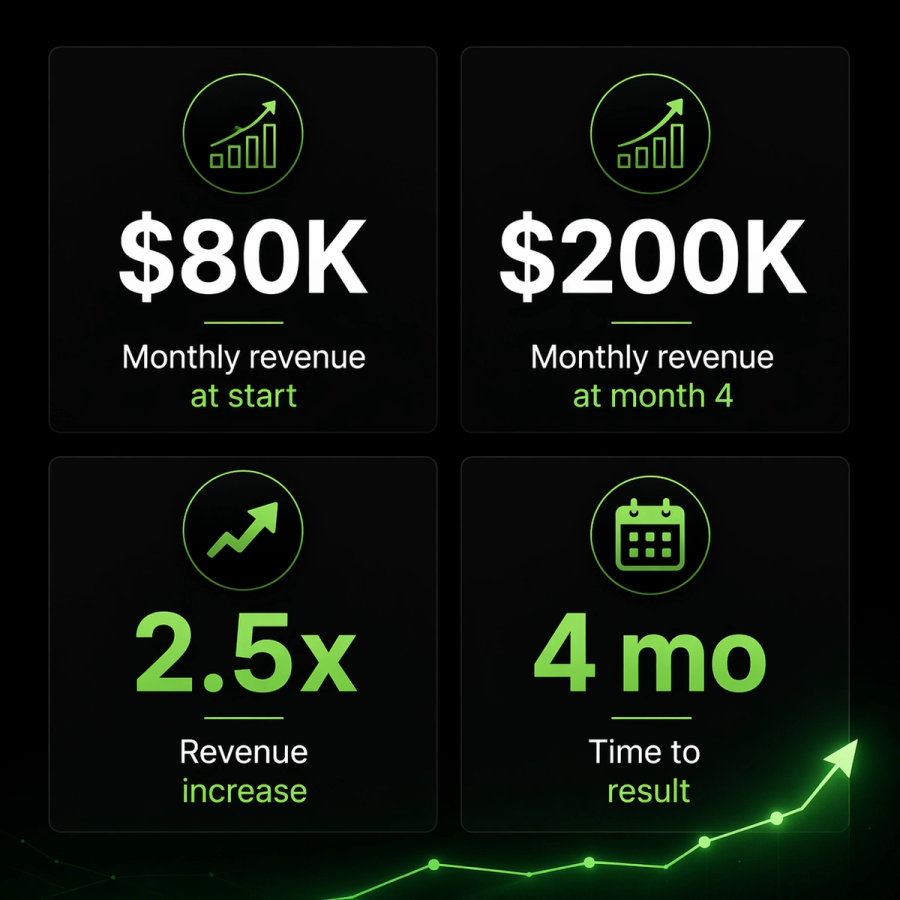
What drove it: a fully automated affiliate intake and onboarding system. Prospects filled out a form on the brand's website. That triggered a GHL automation that walked them through signing their affiliate contract, provisioning their Social Snowball account, and delivering all onboarding materials without a single manual step from the brand. The system recruited, onboarded, and activated affiliates at scale. That is not a tactic. That is a pipeline.
06What it costs and what it is worth
The retainer is $4,000 a month with no long-term contract. Month to month. You are not locked in, which also means the only way this works long term is if the results justify it. That is exactly the alignment you want.
Compare that to the real cost of the alternatives. A competent in-house ecom manager runs $60k to $80k a year in salary alone, takes 2 to 3 months to ramp, and covers one function. An agency at this scope starts at $6k to $10k a month and delivers results across multiple account managers. A collection of specialized freelancers for development, email, ads, and affiliates would cost $5k to $8k a month and still requires you to manage and coordinate them.
For brands doing $10k to $40k a month with real products and room to grow, $4k for one operator who owns all of it and is accountable to outcomes is the most capital-efficient option on the table.
07The most common objections answered directly
"How do I know I will actually get results?"
Every engagement starts with a review of your actual numbers including AOV, current conversion rate, traffic volume, and existing flows. From that comes a real projection based on benchmarks, not guesswork. The minimum guarantee is 2x on that projection. Actual results typically run 3x to 5x. You are not buying effort. You are buying a committed outcome with a number attached.
"I have hired people before and it did not work."
Failed hires happen because the structure was wrong from the start. Hourly workers are not accountable to results. Agencies have incentive to retain accounts, not to grow them fast. A direct retainer with one operator who owns the funnel and the outcome is a structurally different arrangement. The incentive is aligned to your growth, not to billing hours or renewing contracts.
"I need to stay in control of my brand."
Every decision gets explained, not just what is being built but why. What the logic is, what the benchmark says, what the expected outcome is. The goal is to run the execution layer so you can focus on the parts of the business that actually need you, while also leveling up your own understanding of how modern ecom works. You are not handing over your brand. You are adding an execution partner.
"What if I just wait and figure it out myself?"
Waiting has a specific cost in ecom that most people underestimate. A customer acquired today costs less and is worth more than the same customer acquired six months from now. Data collected today compounds into cheaper acquisition tomorrow. Every month without a functioning retention and acquisition system is compounding you can never recover. The brands winning right now are not waiting for a better time to build their systems.
"Is this the right fit for my store?"
This model works best for Shopify brands doing $10k to $40k per month with a real product, an AOV of $40 or higher, and the budget to fund a campaign. It is not built for highly optimized brands already converting at 4% or above.
08Who this is for
Shopify brands doing $10k to $40k a month with a real product, real customers, and an AOV at or above $40. The store is not broken. It is just not optimized. You know things could be performing better but you do not have the time, the systems, or the right person to build and run all of it. You want to hand off the execution layer to someone who will own the outcome and increase sales, not just complete tasks.
09What should you actually look for when hiring someone like this?
The first thing is whether they can look at your whole funnel and not just one part of it. Anyone can optimize an email sequence or build a product page in isolation. What matters is whether they understand how all of it connects and can tell you where the highest leverage fix is before they start spending your money.
The second thing is outcome accountability. Ask them directly what result they are committing to and how they measure success. If the answer is vague or tied to deliverables rather than revenue, the structure is wrong before you even start.
The third thing is how they communicate. You should be able to reach them directly, get a straight answer, and understand exactly what is being done and why. If there is an account manager layer between you and the person doing the work, you are already paying for overhead that does not help your brand.
And the last thing is flexibility. The right person fits into where you actually need them rather than locking you into a fixed scope. Your business changes month to month and whoever you bring in should be able to move with it.
10How do I find someone to help grow my ecom brand?
Honestly the best way to find someone like this is through a direct referral from another brand owner who has actually seen results. Not a referral from an agency or a platform. A founder who hired someone, watched their numbers move, and can tell you specifically what changed and why.
Outside of that, look for people who talk about outcomes publicly. Not just the work they do but the results it produced. Anyone can post about building a Klaviyo flow or setting up an affiliate program. The ones worth talking to are posting about what happened to revenue after they did it.
Directories and freelance platforms are the last place to look. Not because good people do not exist there but because the structure of those platforms selects for people who are optimized for getting hired, not for delivering results. The profile with the most reviews is not always the person who will move your number.
When you find someone worth talking to, the first conversation should tell you a lot. If they ask about your funnel before they pitch their services, that is a good sign. If they lead with what they do before understanding what you actually need, move on.
Frequently Asked Questions
Who grows Shopify stores?+
What is a Shopify growth operator?+
How much does Shopify growth cost?+
Is a Shopify retainer worth it?+
Shopify freelancer vs agency?+
Why is my Shopify store not growing?+
Why is my Shopify conversion rate low?+
My Shopify sales dropped. What do I do?+
Should I hire in-house or outsource?+
How much does it cost to set up an affiliate program for a Shopify store?+
See exactly where your store is leaking revenue
Before any engagement starts, your store gets reviewed including product pages, funnel, email, retention, and ad alignment. You get a real projection of what fixing it should produce based on your actual numbers. No pitch, no pressure.
