How Do You Set Up Ad Retargeting on Shopify
How retargeting ads work, why 98 percent of your visitors leave without buying, and the step by step system that brings them back and converts them.

Most of your website visitors will not buy on the first visit.
The average ecommerce conversion rate is only 1.65 percent. That means 98 percent of the people landing on your store are leaving without purchasing. Spiralytics
Retargeting is how you get them back.
This article breaks down exactly what retargeting ads are, why they work, and how to set up a complete retargeting system for your Shopify store step by step.
01What Are Retargeting Ads?
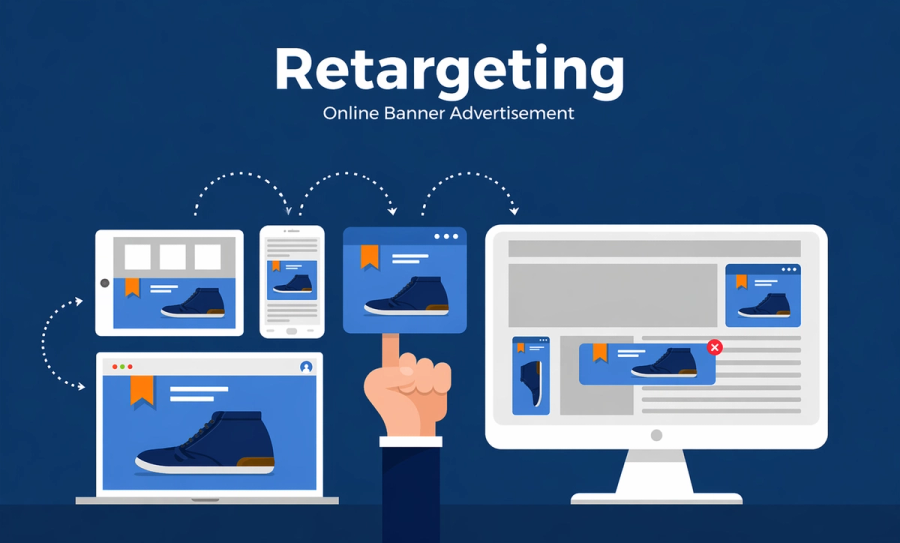
Retargeting ads, also called remarketing, are digital ads shown specifically to people who have already interacted with your brand in some way.
Instead of advertising to completely cold audiences who have never heard of you, retargeting shows ads to people who have:
- Visited your website
- Viewed a specific product page
- Added something to cart but did not complete the purchase
- Watched one of your videos
- Clicked on one of your ads
- Engaged with your social media content
The core idea is simple. Someone showed interest. Something stopped them from buying. You follow up with an ad that gives them a reason to come back and finish the action.
Why Retargeting Works: The Data
The reason retargeting is consistently one of the highest return activities in any ecommerce marketing stack comes down to intent. You are not guessing whether someone might be interested in your product. You know they were. You have evidence.
Retargeted website visitors are 70 percent more likely to convert than visitors who are not exposed to retargeting campaigns. Retargeting ads can increase conversion rates by up to 150 percent compared with standard campaigns that target cold audiences. SQ Magazine
Retargeting delivers an average return on ad spend of 4.2 times overall. Retargeting CPMs have dropped up to 18 percent year over year making 2025 one of the most efficient periods for display retargeting since 2020. NewswireJet
The average CPC for retargeting ads ranges between $0.95 and $1.25, compared to significantly higher costs for cold prospecting campaigns. Retargeting campaigns typically deliver CPA reductions of up to 50 percent compared with campaigns targeting cold audiences. SQ Magazine
The practical implication for Shopify stores is significant. Every visitor you drive to your store through paid ads, organic search, or social media who does not convert on the first visit becomes a retargetable audience. Without a retargeting system that audience is permanently lost. With one you have multiple additional opportunities to convert them at a fraction of the original acquisition cost.
02How Retargeting Ads Actually Work
Understanding the mechanics helps you set it up correctly.
Step 1: A tracking pixel fires when someone visits your store
A small piece of code installed on your website, called a pixel, records visitor behaviour and sends that data back to the ad platform. Meta has the Meta Pixel. Google has the Google Ads Tag. TikTok has the TikTok Pixel. Each one tracks the same core events: page views, product views, add to cart, checkout initiated, and purchase completed.
Step 2: The platform automatically builds audiences from that data
As visitors take actions on your store the platform segments them into audiences based on their behaviour. Everyone who visited the site. Everyone who viewed a specific product. Everyone who added to cart but did not buy. Everyone who reached checkout but did not complete it. These audiences update automatically in real time.
Step 3: Ads are served to those audiences across the platform
Once someone leaves your store they start seeing your ads as they browse Instagram, scroll their Facebook feed, watch YouTube, or use TikTok. Because they already know your brand the ad lands differently than a cold ad would.
Step 4: They return and convert at a higher rate
When a prospect sees a retargeting ad there is a 70 percent chance they will purchase your product over a competitor's. Spiralytics The familiarity creates trust that cold advertising has to work much harder to build.
03The Four Types of Retargeting Ads
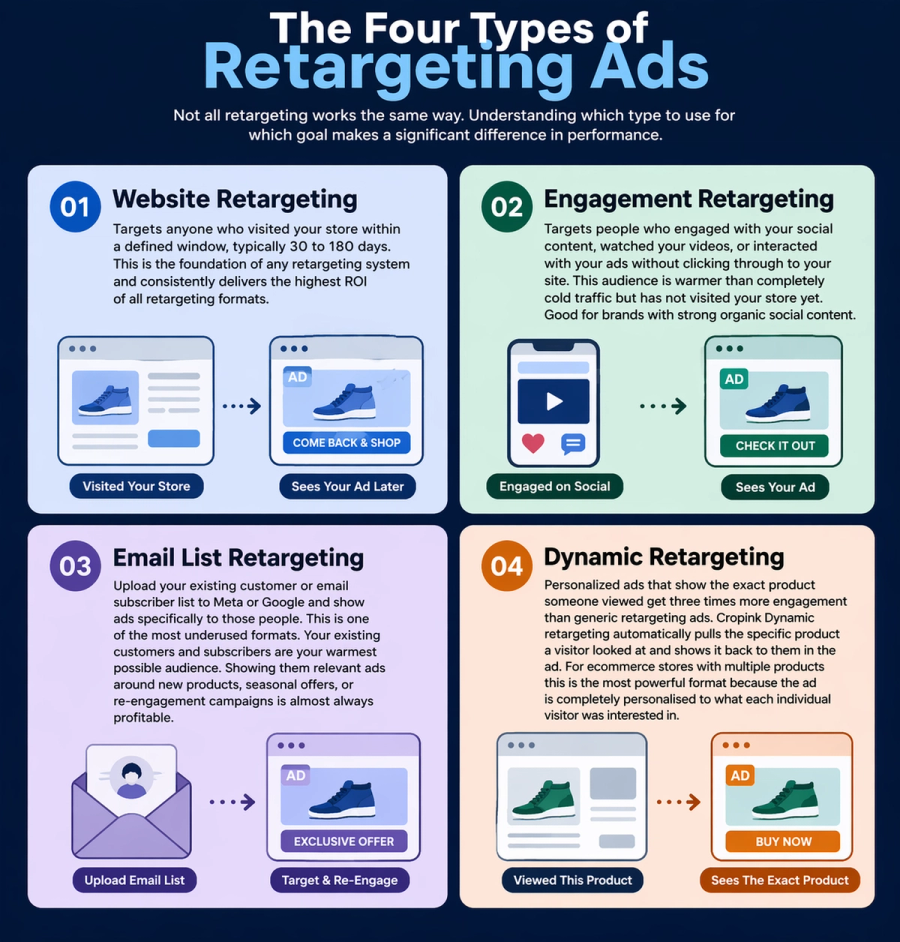
Not all retargeting works the same way. Understanding which type to use for which goal makes a significant difference in performance.
Website retargeting
The most common type. Targets anyone who visited your store within a defined window, typically 30 to 180 days. This is the foundation of any retargeting system and consistently delivers the highest ROI of all retargeting formats.
Engagement retargeting
Targets people who engaged with your social content, watched your videos, or interacted with your ads without clicking through to your site. This audience is warmer than completely cold traffic but has not visited your store yet. Good for brands with strong organic social content.
Email list retargeting
Upload your existing customer or email subscriber list to Meta or Google and show ads specifically to those people. This is one of the most underused formats. Your existing customers and subscribers are your warmest possible audience. Showing them relevant ads around new products, seasonal offers, or re-engagement campaigns is almost always profitable.
Dynamic retargeting
Personalized ads that show the exact product someone viewed get three times more engagement than generic retargeting ads. Cropink Dynamic retargeting automatically pulls the specific product a visitor looked at and shows it back to them in the ad. For ecommerce stores with multiple products this is the most powerful format because the ad is completely personalised to what each individual visitor was interested in.
04How to Set Up Retargeting on Your Shopify Store: Step by Step
Step 1: Install your tracking pixels
Before retargeting can exist you need your pixels firing correctly on your store. Shopify makes this straightforward through native integrations.
For Meta: Go to your Shopify admin, navigate to Sales Channels, add Facebook and Instagram, connect your Meta Business account, and select your pixel. Shopify installs both the browser pixel and Conversions API simultaneously.
For Google: Add the Google and YouTube sales channel in the same way and connect your GA4 property and Google Ads account.
For TikTok: Add the TikTok sales channel and connect your TikTok Business account and pixel.
After installing each pixel go into the respective events manager and use the test events tool to verify that PageView, ViewContent, AddToCart, InitiateCheckout, and Purchase are all firing correctly. If any of these events are missing your retargeting audiences will be incomplete.
Step 2: Define your key audiences
The more specific your audience the better your retargeting performance. Build these segments as a minimum:
- All website visitors in the last 30 days
- Product page viewers in the last 14 days
- Add to cart in the last 7 days
- Checkout initiated in the last 7 days
- Past purchasers in the last 180 days
Cart abandoners and checkout abandoners are your highest intent audiences. Someone who reached checkout chose your product and had a payment method ready. Something specific stopped them. A retargeting ad to this audience should convert at a significantly higher rate than any other segment.
Segmenting retargeting audiences by behaviour such as product views or time spent on site can increase CTR by over 70 percent compared with broad retargeting audiences. SQ Magazine
Step 3: Create ads that match where each audience is in the buying process
This is where most brands get retargeting wrong. They run the same ad to cold audiences and retargeting audiences. The messaging needs to be completely different.
Cold traffic ads are introducing your brand and product to someone who has never seen you. Your message is here is what we do and here is why it matters.
Retargeting ads are talking to someone who already knows you and chose not to buy yet. Your message needs to address what stopped them.
For cold website visitors in the last 30 days: social proof, reviews, case studies, and reasons to trust the brand.
For cart and checkout abandoners: urgency, a specific offer, a guarantee, or a direct reminder of what they left behind. This is where limited time offers and free shipping thresholds can move people who were already close.
For past customers: new products, loyalty offers, and reasons to come back. The messaging should feel like a follow-up from a brand that knows them, not a generic ad.
Step 4: Point retargeting ads to the right destination
Retargeting ad traffic should never go to your homepage. Every retargeting ad should send visitors to the most relevant conversion point for that specific audience segment.
Cart abandoners go directly to their cart or the checkout page. Product page viewers go back to the product page they viewed. Checkout abandoners go directly to checkout. Past customers go to a relevant collection or a specific offer page.
The closer you get the visitor to completing the action they were already taking the higher your conversion rate will be.
Step 5: Set your budget allocation
Most brands under-invest in retargeting because they focus the majority of their budget on cold acquisition. The recommended allocation is 10 to 30 percent of your total ad budget dedicated to retargeting depending on your traffic volume and funnel maturity.
At lower traffic volumes where retargeting audiences are small, allocate closer to 10 percent and focus the majority on building the audience through cold traffic. As your store scales and your retargeting audiences grow the allocation toward retargeting becomes increasingly efficient.
Cap frequency at 4 to 6 impressions per user to minimise fatigue. NewswireJet Showing the same ad to the same person fifteen times does not increase conversion. It creates negative brand association. Rotate creatives every two to four weeks to keep the ads fresh.
Step 6: Track the metrics that actually matter
The three numbers that tell you whether your retargeting is working:
Cost per acquisition from retargeting audiences versus cold traffic. This gap tells you how much more efficient your retargeting is compared to cold acquisition and helps justify the investment.
Conversion rate by audience segment. Cart abandoners should convert at a meaningfully higher rate than general site visitors. If they are not your offer or your ad creative is the problem.
ROAS by campaign. Retargeting campaigns deliver an average ROAS of 4.2 times. If your retargeting ROAS is consistently below two times something in your funnel needs attention. NewswireJet
Kill ads that do not convert after sufficient data. Scale the ones that do.
05The Most Common Retargeting Mistakes
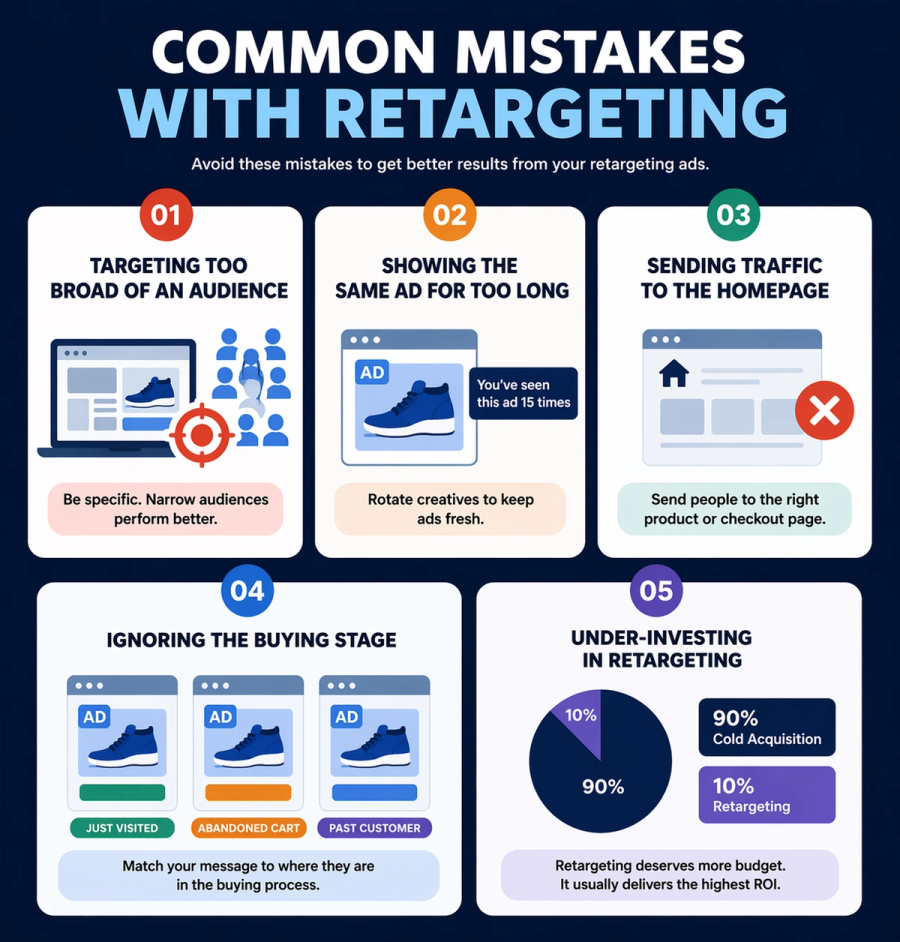
Running retargeting without cold traffic
Retargeting does not create demand. It converts existing demand. If you are not consistently driving new traffic to your store through paid ads, organic content, or social media your retargeting audiences will shrink over time and your retargeting system will starve.
Sending retargeting traffic to a weak landing page
The best retargeting ad in the world cannot save a product page that does not convert. If your product page has weak photography, no social proof, an unclear offer, or a broken mobile experience your retargeting spend is recovering visitors and then losing them again at the same point they left the first time.
Not segmenting audiences
Segmented retargeting campaigns increase CTR by 76 percent and conversions by 147 percent compared with generic retargeting strategies. SQ Magazine Running one retargeting ad to all visitors is leaving significant performance on the table. The effort required to segment properly is minimal compared to the return.
Setting windows that are too long
Shorter windows of 7 to 14 days consistently outperform long-term ones because they capture recent intent before it fades. NewswireJet A visitor from 120 days ago has significantly lower purchase intent than someone who was on your product page yesterday. Weight your budget toward the most recent and highest intent segments.
No creative rotation
Seeing the same ad too often can lead to a 37 percent drop in engagement. Cropink If your retargeting performance is declining and your audience sizes have not changed, creative fatigue is usually the cause. Refresh your creatives every two to four weeks.
Where Retargeting Fits In Your Full Marketing System
This is the part most guides miss entirely.
Retargeting is not a standalone strategy. It is a conversion layer in a larger system. On its own it cannot grow a business because it only works on traffic that already exists. The brands that use retargeting most profitably treat it as one part of a connected system:
Cold traffic ads bring new people into the funnel. Your product pages and offer convert the percentage ready to buy immediately. Retargeting recovers the majority who were not ready on the first visit. Email and SMS flows work in parallel to recover visitors who are identified. Upsells and repeat purchase flows increase the lifetime value of every customer the system acquires.
Each layer feeds the next. Cold traffic builds retargeting audiences. Retargeting converts the warm traffic cold ads paid to generate. Email flows convert visitors that retargeting ads cannot reach. The result is a system where no visitor falls through the gap permanently and the cost of the original acquisition is spread across multiple conversion opportunities.
Retargeting can reduce cart abandonment rates by at least 6.5 percent. There is a four times increase in ad engagement after running a retargeting campaign. DemandSage
That is not a small improvement on a business doing meaningful volume. Every percentage point reduction in cart abandonment and every improvement in ad engagement compounds across every visitor your store receives.
Set up the pixels correctly. Build the audiences. Create the right message for each segment. Point traffic to the right destination. Measure what matters. That is a retargeting system that actually works.
